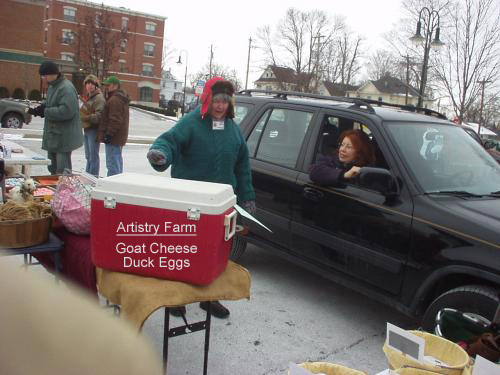
The weather was too cold for some to get out of their cars so we tried our first drive-up service with Debra Bowles.
Author: admin (Page 9 of 12)
Hi Larry,
I wanted to share this information about an upcoming conference held on February 28, 2009, in Oxford, OH that might be of interest. The website is http://www.ourfarmingfuture.org. Included in this email is a brief press release about the conference, which is also available on the website. Registration is free. Please let me know if you have any questions.
Thank you for your time,
John F. Obrycki
2008-2009 Goldman Scholar
Miami University
513-523-8324
http://www.ourfarmingfuture.org
NEWS RELEASE
“FUTURES OF FARMING” CONFERENCE FIELDS TOUGH AG QUESTIONS
Oxford, OH – The “Futures of Farming” conference will be held on February 28, 2009, from 1 – 5 PM at the Marcum Conference Center on Miami University’s Oxford campus. Registration is free, and forms are available through the conference website, www.ourfarmingfuture.org.
The goal of the conference is to critically assess the potential futures for agriculture that exist and foster new ideas and collaborations. With a majority of speakers from Kentucky, Indiana, and Ohio, the event has a regional focus, however speakers from other regions of the country will help broaden the conference’s scope. The meeting is open to the general public, and farmers, policymakers, students, industry representatives, and interested citizens are encouraged to attend. By participating in the conference, attendees have the opportunity to learn more about current agricultural efforts in Ohio and throughout the country, as well as how future initiatives can be shaped by their involvement.
John F. Obrycki, the organizer, looks forward to February 28, 2009. “This conference provides a space and a place for all of us to think about where we are headed,” Obrycki said. “I am excited about the ideas that will be shared and the brainstorming that will occur. Thank you to Miami University and the Joanna Jackson Goldman Memorial Prize for making this possible.”
Discussion topics include transferring farmer knowledge, state approaches to the future of agriculture, preserving natural resources, and the dynamic relationship between energy and agricultural practices. There is also an optional session from 5-7 PM that gives attendees and conference participants an opportunity to continue conversations. Dinner is provided, and information is available on the conference registration form. The conference seeks to attract between 150 and 200 attendees.
The conference is funded by the Joanna Jackson Goldman Memorial Prize from Miami University. John F. Obrycki, Miami University ’08, is the organizer and the current Joanna Jackson Goldman Scholar. This prize provides an opportunity for one graduating senior from the university to pursue an independent self-designed project for one year. Visit http://www.cas.muohio.edu/honors/current/goldman.html for more information about the prize.
The “Futures of Farming” website is http://www.ourfarmingfuture.org. Check back often for updates.
-30-
For more information contact:
John F. Obrycki, Joanna Jackson Goldman Scholar, 513-523-8324, obryckjf@muohio.edu Conference website: http://www.ourfarmingfuture.org
Staying Healthy by Eating in Balance with the Seasons
Traditional Chinese Medicine (TCM) emphasizes the importance of eating very fresh, seasonal foods, which is another reason to appreciate our local Farmer’s Market. In TCM, balance is the key to maintaining optimum health and longevity, as well as living harmoniously in the world.
Chinese medical theory is guided by Taoist thought which teaches that the more in harmony we stay to the rhythms and cycles of nature, the healthier and more balanced we will be. The body is viewed as an extension of the natural world and strongest when in balance with it. This is a dynamic balance, as the seasons are continuously waxing and waning. In spite of our modern lifestyle, which insulates us to a great degree from nature, millions of years of evolution have linked our bodies to nature’s rhythms.
This concept of balance is most directly expressed in our choice of food. The Chinese dietary tradition is to eat foods which harmonize the body, helping it adapt to the demands of the season. Foods should be chosen to balance the body and strengthen it against disease, as well as for sustenance. Each of the organ systems has a season and corresponding flavor associated with it. In winter, the storage season, the flavor is bitter and the Kidneys and Bladder are emphasized. At this time of the year the body’s energy or “qi” (pronounced “chee”) is said to gather in the body’s core. It is the season when living creatures conserve energy and build strength in preparation for spring.
Strengthening, warming foods such as soups, root vegetables, nuts, small amounts of meat, and porridges are appropriate during winter. This is a good time to boost the constitution and alleviate symptoms associated with chronic conditions. Another very important consideration is to balance the type of food recommended for the season with your individual constitutional needs. For instance, if you have a “hot” constitution” you may be better off balancing seasonal eating with some cooling foods like (cooked) dark leafy vegetables. In general, TCM holds that cooked (but not greasy) foods are best for one’s digestive health and assimilation of nutrients, and this is especially true in cold seasons.
Following are examples of foods suited to the winter season, many of which can be found at the Farmer’s Market:
• eggs, lamb, beef, chicken
• sweet potatoes, potatoes
• nuts, seeds, chestnuts
• leeks, escarole, kale
• rosemary, garlic, cooked ginger
• mushrooms
• barley, millet and other grains
• wine, hops, vinegar, black tea
Here are a few modified traditional winter recipes for hearty winter soups. All should be served hot and no more than 1 ½ cups per person.
(Green) Turnip Soup*
This is a very simple Chinese soup said to cleanse toxins from the body. It is not considered to be too warming, but is neutral in character.
1 lb. turnips**
3 medium carrots
8 oz. locally grown pork neck bones or pork ribs cut into bite sized pieces
generous pinch pepper
pinch of sugar
finely sliced spring onion
Scrub, trim and peel the turnip. Cut the turnip lengthwise into quarters, then cut crosswise into 1-inch pieces. Trim the ends of the carrots and cut on the diagonal slice into ½ inch thick slices.
In a 2 1/2-quart saucepan, bring 2 quarts of water and the pork to a boil over high heat. Skim scum off, and add turnip and carrots, returning to a boil. Cover, reduce heat to low and simmer 3 hours. If used neck bones, remove from soup. Add pepper, salt, sugar to taste, garnish with spring onion and serve hot.
*modified from “The Wisdom of the Chinese Kitchen,” by Grace Young
**Chinese green turnips are traditionally used in this soup, but use what you can find
Lamb Stew*
This tonic stew is much more warming in nature and would not be appropriate for those with a hot constitution. In this case pork, which is neutral in temperature, could be substituted.
2 TB cooking oil
1 lb. lamb, cut into 1 ½ inc cubes
½ cup soy sauce
1 ½ teaspoons sugar
2 t. cooking wine
6 slices ginger
2TB chopped onion
8 cups water
¼ t. anise seed
½ cup potato, diced
2 carrots, cut into small pieces
Heat oil in wok or large soup pot. Add lamb, soy sauce, sugar and cooking wine, and stir-fry lamb for 5 minutes or until brown. Add 4 cups of water, ginger, onion, and anise and simmer covered on low heat for 1 ½ hours. Add carrot and potato (and more water if necessary) and simmer for 20 minutes more. Serve hot.
*from “The Healing Cuisine of China”, by Zhuo Zhao & George Ellis.
Walnut Soup*
This last recipe is eaten as a popular snack or dessert. Walnuts, looking like miniature brains, have long been believed by the Chinese to tonify the brain and to contribute to longevity. My Chinese professors at acupuncture school often urged us to eat more walnuts to combat the wear and tear on our brains from studying. Interestingly, researchers at Tufts University** have found that diets high in walnuts do reverse a number of parameters of brain aging in senior rats.
2 cups shelled walnuts
¼ cup rice flour
3 oz. turbinado sugar
Preheat oven to 350 degrees. Bring 1 quart water to high boil in large saucepan. Add walnuts, boil for 1 minute, drain well. Spread walnuts on foil or parchment lined cookie sheet and bake til golden and fragrant, about 15 minutes. Cool on rack.
Grind with ½ cup cold water in blender or food processor until nearly consistency of smooth paste. Add ½ more cup of cold water, scraping down sides and blend til almost smooth.
Wisk 1 cup water and rice flour in large saucepan til smooth, then wisk in walnut puree and 2 ½ cups more water. Heat over medium high heat, whisking constantly until it comes to a boil. Add turbinado sugar, reduce heat, and simmer 10 more minutes, whisking frequently. Add water if necessary; it should be about as thick as a light cream soup. Serve hot.
*from “The Wisdom of the Chinese Kitchen,” by Grace Young
**www.sciencedaily.com/releases/2007/11/071106122843.htm
For more information on Chinese dietary therapy, Traditional Chinese Medicine or acupuncture, you can go to acupuncture.com or
www.aaaom.org/CHINESE%20DIETARY%20THERAPY.htm
There are a number of really lovely books with wonderful recipes and information on Chinese dietary therapy, like “The Wisdom of the Chinese Kitchen, by Grace Young, and “A Spoonful of Ginger”, both of which are in the Oxford library collection.
“The Healing Cuisine of China” by Zhao and Ellis, “Chinese System of Food Cures” by Henry Lu, and “The Tao of Healthy Eating,” by Bob Flaws, are references on Chinese Dietary therapy, which focus more on food remedies.
You can reach Robin McLennan, writer of this article, with questions or comments at:mail@robinmclennan.com. She is a Licensed Acupuncturist, and received her Masters of Traditional Oriental Medicine (M.T.O.M.) degree from the Pacific College of Oriental Medicine, New York NY, in 1997. She has practiced in New York City, Easton, PA, and currently in Oxford, Ohio. Robin is NCCAOM National Board Certified and holds licenses to practice acupuncture in New York, Pennsylvania, Ohio and Indiana.
Come and enjoy farm fresh ingredients even in winter. The Oxford Farmers Market Uptown will be held on the 3rd Saturday from November through April. 9:30 until Noon. Hope to see you there.
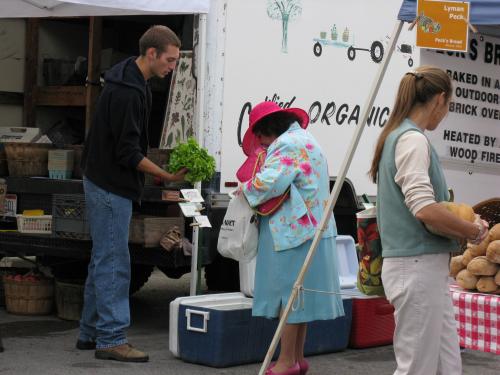
Dressed in best, or come-as-you-are, everyone is comfortable at Oxford Farmers Market Uptown where they find everything from Locust Run Farms organic lettuces to Lyman Peck’s Clay-Oven-Baked breads plus Artisan Alley.
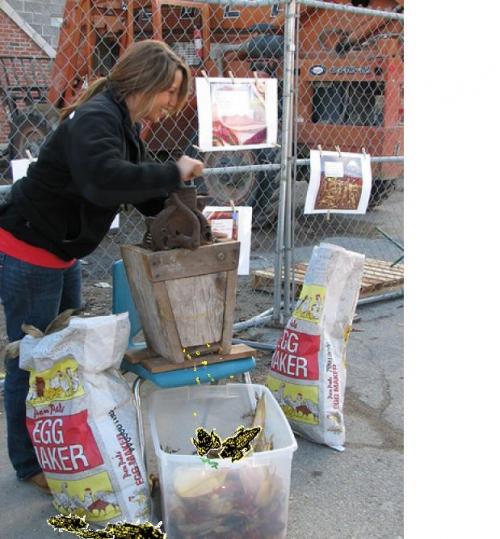
Young and old and in-between enjoyed the old-fashioned hand-crank corn sheller during Oxford Farmers Market Uptown Harvest Party/Customer appreciation.

A photo of the market taken by Mihir Devare.
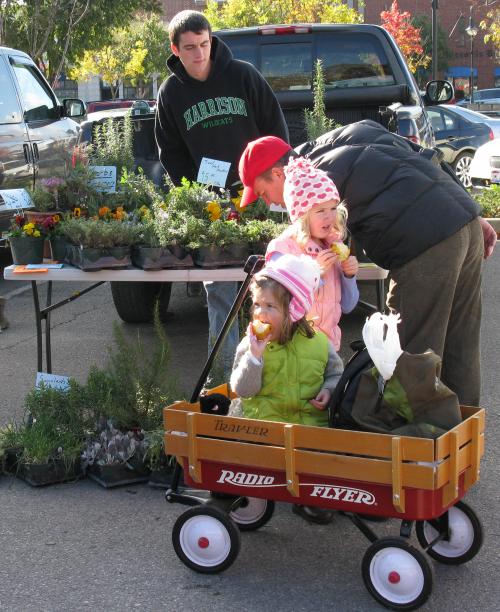
Two young marketeers chow down on Boulder Belt Eco Farm pears while Dad looks over attractive Pansy/Herb planters offered by Adopt-A-Plant.
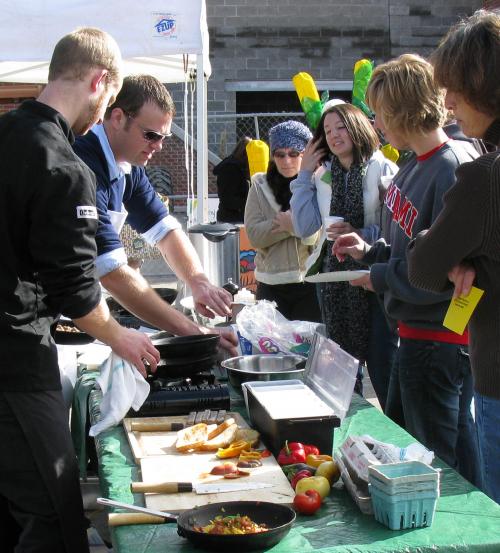
Everybody loves a cooking demo: Blake from Kona Bistro and Joel from High Street Grill gathered local foods, colors and crowds all together for a delicious scene at Oxford Farmers Market Uptown!

Rita proudly displays her SPROUTS gourd made during Oxford Farmers Market Uptown’s Harvest Party/Customer Appreciation. The gourds were raised by vendor Scwab’s Garden and Gourds.